


From Relational Aesthetics to Civic Agency: Evaluating the Invisible Infrastructure of Theatre-Based Inclusion
Introduction: The ECHO Operational Framework and WP2 Progress
The ECHO project—Empowering Cultures through Theatre for European Migrant Youth—is a Transnational Erasmus+ Cooperation Partnership in Youth (KA220-YOU) designed to address the interconnected challenges of social inclusion, civic engagement, and employability for young migrants and refugees aged 18 to 30. By integrating applied drama with non-formal education strategies, the project aims to establish scalable and innovative integration pathways across the European youth sector.
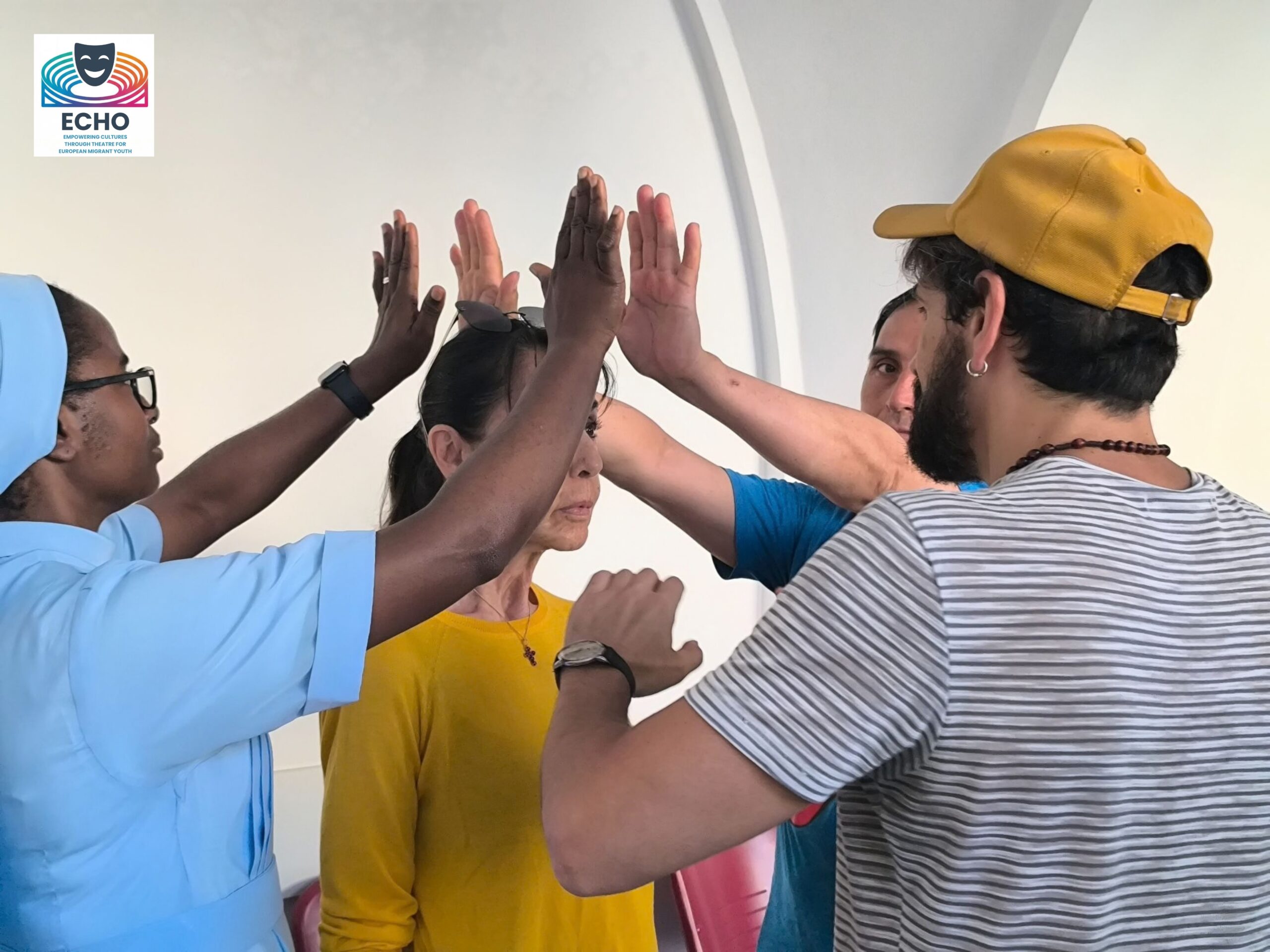
During the first seven months of the project lifecycle, the cross-border consortium has successfully finalized the operational path of Work Package 2 (Theatre of Inclusion). This phase achieved the implementation of localized theater workshops and public awareness-raising performances across Italy, Spain, Portugal, and Ireland, engaging young migrants and local peers in co-creative spaces.
When analyzing these milestones under European qualitative assessment criteria, a theater-based inclusion activity should never be evaluated merely as a tool for public entertainment or short-term output production. It must instead be recognized as a temporary, safe social ecosystem where vulnerable young adults build the psychological framework necessary to claim their rightful place within democratic systems. As the project transitions toward the active citizenship modules of Work Package 3, this article examines the process-oriented variables and invisible infrastructure built during our field workshops.
1. Bourriaud’s Relational Aesthetics on the Non-Formal Stage
To evaluate a theater workshop without relying strictly on technical performance outcomes, we must look to the sociological framework of Relational Aesthetics proposed by Nicolas Bourriaud (1998). Bourriaud defines relational art as a practice that takes as its theoretical and practical point of departure the whole of human relations and their social context, rather than an independent and private space.
In the national workshops conducted across the five European partner countries, the empty stage was not used to produce a traditional aesthetic commodity or train professional actors. Instead, it was deployed as a dynamic platform for co-designing human interactions.
“The theater workshop shifts the focus from the artistic product to the relational process. The art produced is not an object, but a temporary micro-community established through shared physical space and collective intent.” (Bourriaud, 1998, p. 22).
By focusing on ensemble exercises, physical synchronization, and non-verbal communication, the facilitators bypassed the initial spoken language barriers that often isolate newly arrived third-country nationals. Somatic movement became a democratic, pre-linguistic vocabulary. In this way, the laboratory operates as an interactive simulator where social trust is engineered step-by-step, transforming an uncoordinated group of isolated individuals into a supportive peer network.
2. Turner’s Liminality and the Construction of “Communitas”
The psychological safety constructed during the theater lab is deeply linked to the concept of Liminality, as articulated by anthropologist Victor Turner (1969). In Turner’s framework, the liminal phase is an intermediate, “threshold” state where individuals are stripped of their pre-existing social statuses, legal labels, and institutional classifications.
For young migrants, refugees, and asylum seekers, daily life is heavily restricted by external bureaucratic systems and rigid administrative categories. The ECHO workshop acts as a deliberate liminal sanctuary. Within this protected learning environment, which is governed by strict ethical and non-formal safety standards, traditional social hierarchies are completely suspended.
By removing the pressure of language evaluation and traditional grading, participants enter what Turner (1969) terms communitas—a state of intense, unmediated human fellowship. This shared vulnerability allows the youth to re-negotiate their identities free from external social stereotypes. The theater lab serves as a protected training ground: before a vulnerable individual can step into a public community center to advocate for their rights, they must first experience the bodily confidence of sharing a room with others without fear of judgment.
3. Structural Transition: From Somatic Capital to Civic Capital
The transition from Work Package 2 to Work Package 3 represents a crucial pedagogical evolution: the conversion of somatic capital into civic capital. This process relies on lowering the Affective Filter, a linguistic and psychological concept developed by Stephen Krashen (1982). Krashen argues that high anxiety, low self-esteem, and fear of error act as a mental barrier that blocks not only language acquisition but active social integration.
The closing of our inclusion labs shows that by stabilizing the group’s socio-emotional well-being through non-verbal drama, the affective filter is significantly lowered. The participants’ personal expression is validated by their peers, building a secure foundation of self-worth. This relational capital forms the mandatory infrastructure for the next stage of our project: moving from body language to spoken dialogue, where youth will use their voices to explore rights, democratic negotiation, and community collaboration in total harmony with our strategic communication milestones.
Conclusion: Fostering a Sustainable Open Legacy
Evaluating the immaterial results of the theater laboratory demonstrates that social inclusion cannot be rushed or measured solely through numbers. By investing heavily in process-based learning during WP2, the ECHO consortium has established a durable foundation of trust across its territorial networks. This approach ensures that the upcoming civic labs (WP3) and professional orientation modules (WP4) will build upon a real, deeply rooted community of active participants.
By documenting this transition through open-access digital resources, the project offers a replicable, high-quality model for youth workers across Europe, directly translating the core values of solidarity and respect for diversity into permanent educational assets.
Every voice carries an echo, and every body has a story that deserves to be heard. As we close this foundational chapter of our theater workshops, we want to hear from you: how can art break down the invisible barriers in your local community? Drop your thoughts below and stay tuned for the launch of our full Multimedia Toolkit
Website: https://www.echo4inclusion.eu/
Facebook https://www.facebook.com/profile.php?id=61584267096657
Instagram https://www.instagram.com/echo.project2025/
References
- Bourriaud, N. (1998). Relational Aesthetics. Les Presses du Réel.
- ECHO Consortium. (2025). Work Package 2: Theatre of Inclusion Operational Framework. In Application ECHO 2025 KA220-YOU-Cooperation partnerships in youth (Form ID KA220-YOU-430BD457).
- ECHO Consortium. (2025). Work Package 5: Dissemination and Communication Strategy. In Dissemination Plan – LDC.docx.
- Fondazione Monnalisa. (2025). Sistema di Monitoraggio della Qualità e della Cooperazione. In PIANO QUALITA – ITALIANO.docx.
- Krashen, S. (1982). Principles and Practice in Second Language Acquisition. Pergamon Press.
- Turner, V. (1969). The Ritual Process: Structure and Anti-Structure. Aldine Transaction.
🇪🇺 European Visibility & Open Access License Statement
This academic brief is an intellectual output of the ECHO project, co-funded under the Erasmus+ program of the European Union. In accordance with the open access mandates of the European Commission, this asset is available for public redistribution and replication.
Open License: Licensed under CC BY-SA 4.0 — © ECHO Project, Co-funded by the European Union.
Views and opinions expressed are however those of the author(s) only and do not necessarily reflect those of the European Union or the European Education and Culture