


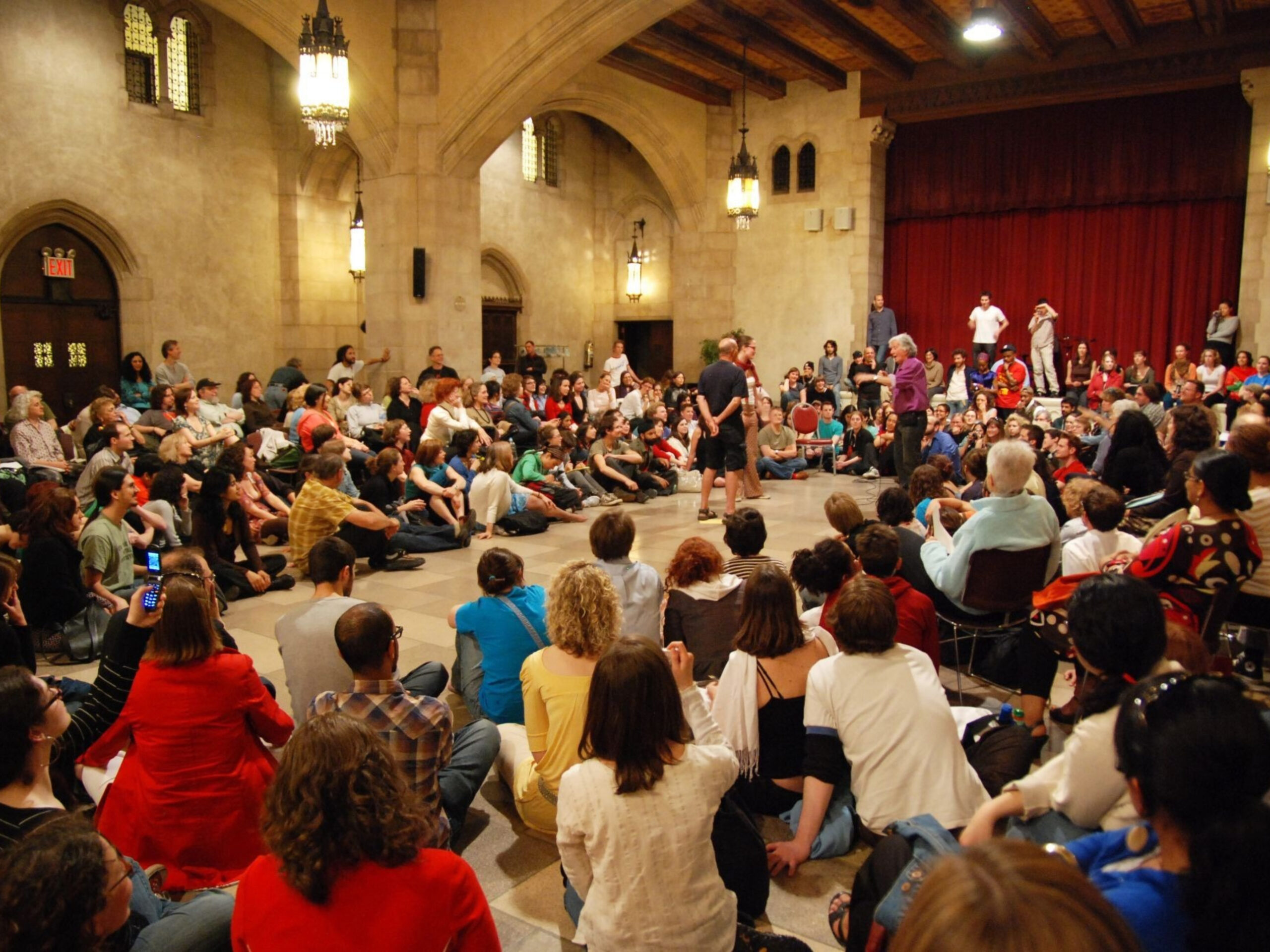
Learning by Doing: Embodied and Experiential Learning in Theatre Workshops
How the stage becomes a classroom — and why the body knows what the mind forgets.
Introduction
There is a particular kind of knowing that cannot be found in textbooks. It lives in the tension of a held breath before delivering a monologue, in the way two actors discover trust through an improvisation exercise, in the physical memory of a gesture rehearsed until it becomes instinct. Theatre has always been, at its core, a laboratory of human experience — and increasingly, educators and researchers are recognising its potential as one of the most powerful vehicles for deep, transformative learning.
This article explores how theatre workshops operate as spaces of embodied and experiential learning, drawing on established pedagogical theory and contemporary research to argue that learning through the body and through lived experience is not merely a complement to traditional instruction — it may be fundamental to how we learn best.
From Dewey to Kolb: The Foundations of Experiential Learning
The idea that experience is the starting point of genuine learning is far from new. John Dewey, writing in the first half of the twentieth century, argued that education must be grounded in real, meaningful experience rather than passive absorption of information. For Dewey, learning was not something done to students but something that emerged from their active engagement with the world (Dewey, 1938).
Decades later, David Kolb built on Dewey’s insights to develop one of the most influential models in education: the Experiential Learning Cycle. Kolb proposed that effective learning unfolds through four stages — concrete experience, reflective observation, abstract conceptualisation, and active experimentation — and that learners must move through all four to truly internalise new knowledge (Kolb, 1984). Theatre workshops, almost by design, push participants through this entire cycle: an improvisation exercise (concrete experience) is followed by group discussion (reflective observation), the identification of patterns and principles (abstract conceptualisation), and a second attempt that applies those insights (active experimentation).
What makes theatre particularly suited to this model is its iterative, rehearsal-based nature. Unlike a lecture, which typically offers information once, the workshop format invites repeated cycles of doing, reflecting, and redoing.
The Body as a Site of Knowledge
Experiential learning theory provides a strong foundation, but it does not fully account for what happens in a theatre workshop. For that, we need to turn to a second, complementary tradition: embodied cognition.
Embodied cognition challenges the long-standing Western assumption that the mind and body are separate — that thinking happens exclusively “in the head.” Researchers in this field argue that cognition is fundamentally shaped by our bodily interactions with the environment. The way we move, gesture, and physically inhabit space is not merely an expression of thought — it is constitutive of thought itself (Varela et al., 1991; Johnson, 2007).
In theatre, this principle is not theoretical — it is the daily reality. When an actor explores a character’s physicality — a particular gait, a way of holding the shoulders, a rhythm of breathing — they are not decorating a pre-existing mental concept. They are discovering the character through the body. Stanislavski recognised this early on, developing his “method of physical actions” precisely because he observed that emotional and psychological truth could be accessed more reliably through physical engagement than through purely intellectual analysis (Stanislavski, 1936/2008).
This has profound implications for education. If knowledge is not merely stored in the brain but distributed across the body and its interactions with the environment, then pedagogies that engage the whole person — movement, sensation, spatial awareness, interpersonal contact — are not peripheral “enrichment activities.” They are tapping into the very architecture of human cognition.
Theatre of the Oppressed: Learning as Liberation
Perhaps no practitioner has demonstrated the educational power of theatre more forcefully than Augusto Boal. Drawing on the critical pedagogy of Paulo Freire, Boal developed Theatre of the Oppressed as a set of techniques in which participants — whom he called “spect-actors” — do not simply watch a performance but actively intervene in it, stepping onto the stage to rehearse responses to real situations of social injustice (Boal, 2000).
Boal’s work makes explicit what is implicit in all good theatre education: the workshop is a space where participants can safely experiment with new behaviours, identities, and possibilities. Freire argued that the traditional “banking model” of education — in which knowledge is deposited into passive students — is fundamentally dehumanising (Freire, 1970). Boal translated this critique into theatrical form, creating workshops in which the body becomes the instrument of critical thinking and social rehearsal.
This connection between theatre, critical awareness, and embodied practice has been taken up widely in the field of applied drama, where practitioners use theatrical methods in educational, community, and therapeutic settings (Nicholson, 2014). Whether the context is a school, a prison, a refugee centre, or a corporate training room, the underlying principle remains the same: when people engage physically and emotionally in a shared dramatic situation, they learn in ways that purely discursive methods cannot reach.
What Research Tells Us
The theoretical case for embodied and experiential learning in theatre is compelling. But what does the empirical evidence say?
A growing body of research supports the idea that arts-based, embodied pedagogies produce measurable learning outcomes. Studies have shown that drama-based instruction improves reading comprehension, empathy, perspective-taking, and social-emotional competencies in school-aged children (Lee et al., 2015). In higher education, theatre-based methods have been used effectively to teach subjects as diverse as medical ethics, intercultural communication, and leadership (Joronen et al., 2013).
Neuroscience, too, is lending support. Research on mirror neurons and simulation theory suggests that when we observe or perform actions, the same neural circuits are activated as when we experience those actions in real life — providing a neurological basis for why theatrical role-play feels so “real” and why the learning it generates can be so durable (Gallagher, 2005).
The Workshop as Pedagogical Space
It is worth pausing to consider what makes the theatre workshop — as distinct from a theatre performance — such a uniquely effective learning environment.
First, the workshop foregrounds process over product. Participants are not preparing for an audience; they are exploring, failing, and discovering in a low-stakes setting. This aligns with what educational psychologists call a “mastery orientation” — a focus on learning and growth rather than on evaluation and judgment (Dweck, 2006).
Second, the workshop is inherently social and collaborative. Theatre cannot be done alone. Every exercise involves negotiation, listening, adaptation, and co-creation. These are not incidental features — they are the core of the learning experience. Vygotsky’s concept of the Zone of Proximal Development — the idea that learners develop most effectively through interaction with more skilled peers and facilitators — finds a natural home in the ensemble-based dynamics of the workshop (Vygotsky, 1978).
Third, the workshop engages multiple modalities simultaneously: movement, voice, emotion, imagination, spatial awareness, and interpersonal attunement. This multimodal engagement means that learning is encoded across several channels, making it more robust and more easily retrievable than learning encoded through a single channel such as text (Shams & Seitz, 2008).
Implications for Education and Training
The lessons of theatre workshops extend well beyond the arts. In an era of increasing interest in competence-based education, active learning, and learner-centred pedagogies, the methods developed in theatre over centuries offer a ready-made toolkit for educators in any discipline.
For vocational education and training (VET), where practical, transferable skills are paramount, theatre-based methods offer a way to develop so-called “soft skills” — communication, teamwork, adaptability, creative problem-solving — that are consistently identified by employers as critical but are notoriously difficult to teach through conventional instruction.
For higher education, the integration of embodied and experiential approaches can help address the well-documented limitations of lecture-based teaching, particularly in fields that require ethical reasoning, interpersonal competence, or the ability to act under uncertainty.
And for lifelong learning and professional development, theatre workshops offer a space where adults can step outside their habitual roles, experiment with new perspectives, and develop the kind of reflective, adaptive intelligence that complex modern workplaces demand.
Conclusion
Theatre workshops are not a gimmick or a warm-up exercise. They are sophisticated learning environments that integrate body, mind, emotion, and social interaction in ways that conventional pedagogies rarely achieve. The convergence of experiential learning theory, embodied cognition research, and decades of applied drama practice points to a clear conclusion: when we learn by doing — truly doing, with our whole selves — we learn more deeply, more durably, and more humanely.
The stage, it turns out, has always been a classroom. It is time our classrooms returned the favour.
References
Boal, A. (2000). Theatre of the oppressed (New ed.). Pluto Press.
Dewey, J. (1938). Experience and education. Kappa Delta Pi.
Dweck, C. S. (2006). Mindset: The new psychology of success. Random House.
Freire, P. (1970). Pedagogy of the oppressed. Continuum.
Gallagher, S. (2005). How the body shapes the mind. Oxford University Press.
Johnson, M. (2007). The meaning of the body: Aesthetics of human understanding. University of Chicago Press.
Joronen, K., Rankin, S. H., & Åstedt-Kurki, P. (2013). School-based drama interventions in health promotion for children and adolescents: Systematic review. Journal of Advanced Nursing, 64(1), 19–36. https://doi.org/10.1111/j.1365-2648.2008.04634.x
Kolb, D. A. (1984). Experiential learning: Experience as the source of learning and development. Prentice Hall.
Lee, B. K., Patall, E. A., Cawthon, S. W., & Steingut, R. R. (2015). The effect of drama-based pedagogy on PreK–16 outcomes: A meta-analysis of research from 1985 to 2012. Review of Educational Research, 85(1), 3–49. https://doi.org/10.3102/0034654314540477
Nicholson, H. (2014). Applied drama: The gift of theatre (2nd ed.). Palgrave Macmillan.
Shams, L., & Seitz, A. R. (2008). Benefits of multisensory learning. Trends in Cognitive Sciences, 12(11), 411–417. https://doi.org/10.1016/j.tics.2008.07.006
Stanislavski, C. (2008). An actor’s work (J. Benedetti, Trans.). Routledge. (Original work published 1936)
Varela, F. J., Thompson, E., & Rosch, E. (1991). The embodied mind: Cognitive science and human experience. MIT Press.
Vygotsky, L. S. (1978). Mind in society: The development of higher psychological processes. Harvard University Press.

